

It’s funny how things turn full circle. Ten years ago, I stood in the yard late at night on my chicken farm permission with half a dozen thermal monocular spotters to review for a magazine. Until then I’d never used one.
I took the first – I can’t remember the make and model – out of its packaging, and once I’d worked out where to put the battery and switch it on, peered through it. Epiphany. I was blown away. All of a sudden night turned into day and everything with a heartbeat stood out like a sore thumb – even bugs and moths.
I remember thinking that shooting would never be the same and I had to get one of my own. I was right, and I did. Quite simply, using a thermal spotter has been the most significant development in my shooting career, surpassing even the rise of PCP rifles over springers.
And it’s got even better. More and more companies have jumped on the bandwagon. Competition has increased. Quality has improved. And best of all, prices have come down; some of the thermal spotters you can buy today cost a fraction of the ones I tested all those years ago and perform at a higher level.
The thermal spotter I used on my most recent ratting trip proves the point. Made by DNT Optics, the Hound H635R is priced at £1499.99. Now, that’s not an insignificant chunk of cash. In fact, unless you have a top of the range PCP rifle, it’s likely to be the most expensive piece of kit you own. But if it is a financial step too far, the Hound H325R costs £899.99.
Either way, you’ll get a light and compact spotter you can hold easily with one hand until you drop it into your pocket, unless you choose to use the lanyard or belt pouch it comes with.
Below: The DNT Hound thermal spotter delivers exceptional performance and great value
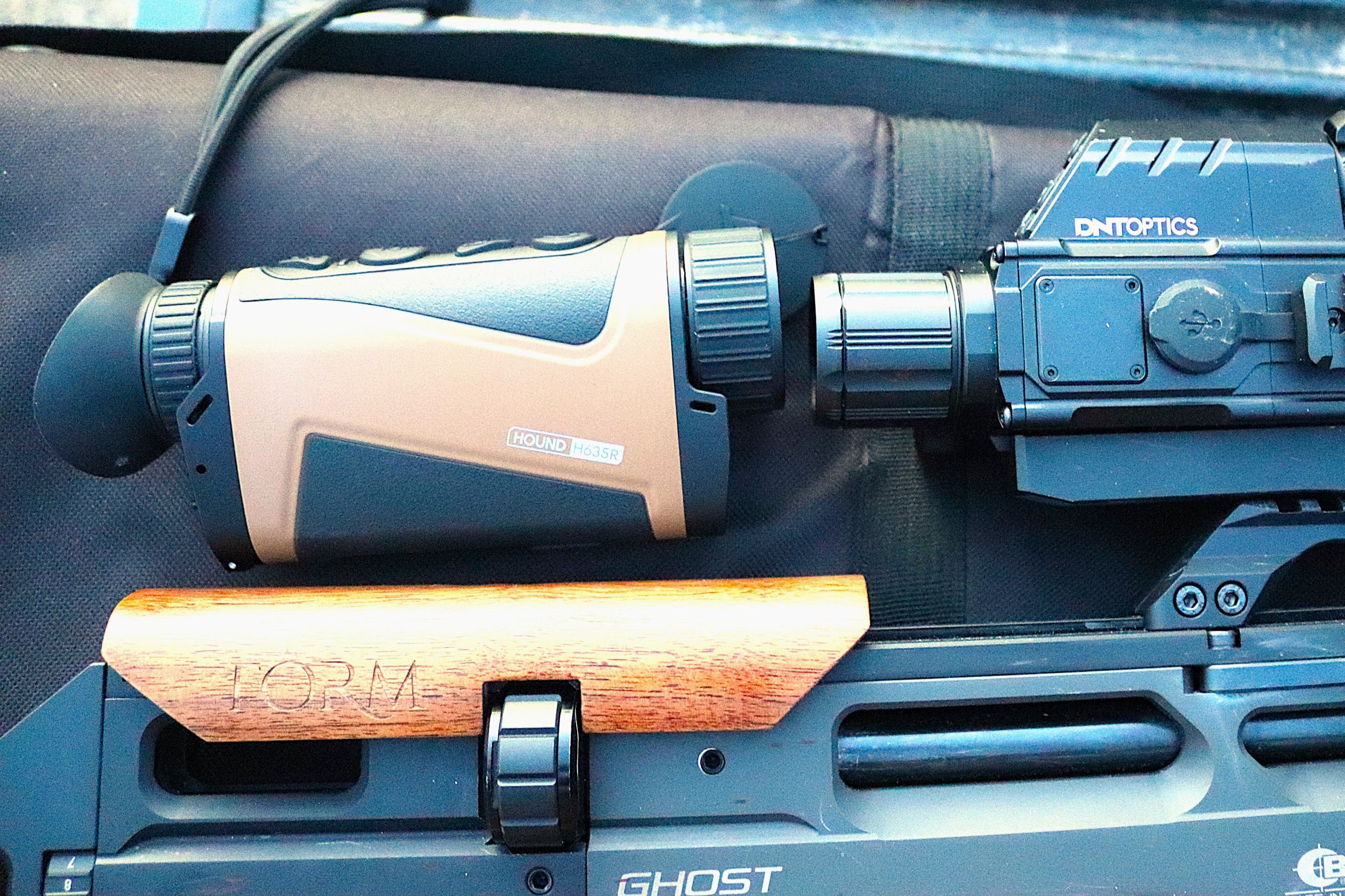

The thing with thermal spotters is that, to oversimplify things, you’re paying for the thermal sensor; the higher the specification, the greater its ability to detect variances in temperature and translate them into a clear image.
But having used dozens of different spotters over the years, it’s dawned on me that the entire point of a thermal spotter is to reveal something, often in the dark, that has the potential to be a legitimate target. More expensive spotters will identify straight away, and in great detail, if you’re looking at a rabbit or a hedgehog, but cheaper spotters with lower spec sensors will still indicate something is there, even if it is a more indistinguishable blob, so you can use your scope to confirm if it is a legitimate target.
The happy middle ground is the sweet spot between a spotter that won’t break the bank and has good enough performance at and beyond airgun ranges, to provide an image that is clear enough to identify a target straight away. The Hound H635R is easily good enough in most scenarios to do exactly that.
One of the key indicators to the performance of any thermal product is the Noise Equivalent Temperature Difference (NETD) rating, which is measured in millikelvins (mK) and describes the smallest temperature difference that a thermal imaging sensor can detect. In other words, the lower the NETD, the sharper the image is likely to be. A 25mK NETD sensor can detect a 0.025°C variance in temperature, whereas a 50mK NETD sensor requires double that to deliver an image.
Whilst a thermal sensor’s NETD rating describes its ability to detect temperature differences, its pixel rating is a good guide for how detailed the image will be. In basic terms, the more pixels an image has, the higher the resolution, or clarity, will be.
The Hound H635R has an 18mK NETD 640x512 pixel sensor with a 35mm objective lens. The H325R also has an 18mK NETD sensor, but a lower pixel rating of 384x288 and a 25mm lens.
Now, I’m aware I just went a little bit technical there, but choosing a thermal spotter can be a daunting task. NETD and pixels are not the be all and end all when it comes to describing a product’s capability, especially as most, like the DNT Optics spotters, are augmented by software algorithms, but they’re a pretty good basic guide.
To reinforce that point, the Hound H635R spotter I used for my ratting trip has plenty more features all designed to exploit the benefit of that sensor to help you identify targets and make you more successful in the field.
There are, for example, four colour palettes – black, white and red hot as well as a blue tinted ‘iron hot’ mode – and a 1,200-yard rangefinder that combines with a ballistic calculator function.
Base magnification is 2x with a digital zoom of 2-8x. As with all thermal products, the higher up the range you go, the more blurry the image becomes. For airgun use though, the base 2x setting not only maximises image clarity on a 1024x768 pixel Micro-OLED display, but also provides a wide field of view, which is useful when scanning for rats or rabbits.
Powered by an 18650 re-chargeable battery, DNT Optics says you can expect a run time of around five hours. Alternatively, you can use a 5v USBC type external battery, but it’s far easier to take a couple of 18650 spares as it takes seconds to pop in a new one. Finally, the chunky buttons on top of the spotter are easy to operate and include one to record footage onto a 32GB internal memory.
Below: A rat clearly displayed on the screen of the DNT Hound H635R
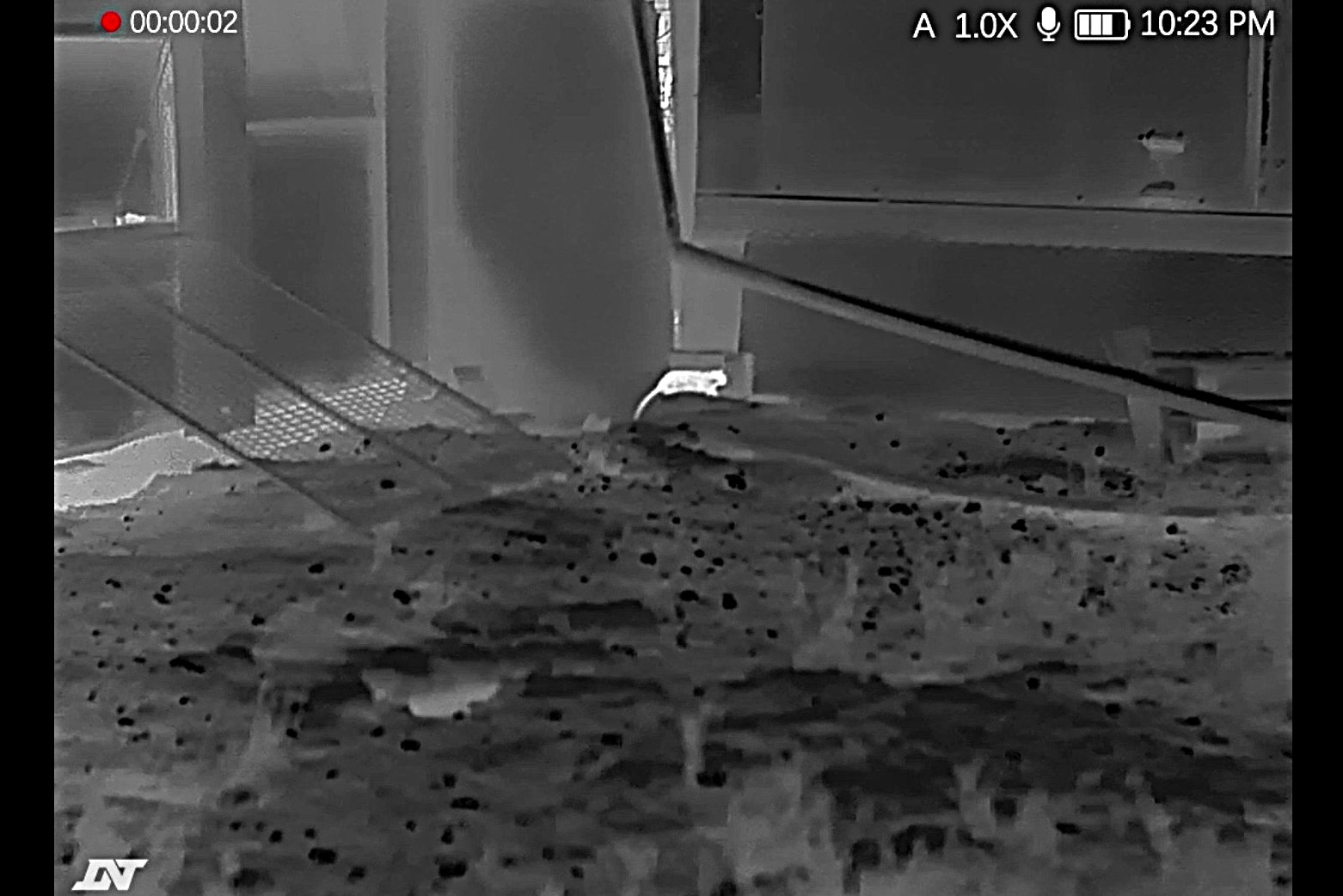
Stood in the yard at the chicken farm, I soon appreciated that the Hound weighs only 340g and measures just 157mm, making prolonged scanning of the chicken shed very comfortable.
Rats are a year-round issue at the farm; although numbers increase during the winter when there’s less natural food and more flooding, there’s a sizeable resident population. Not only does their presence represent a health risk to the farm workers, they directly impact the farm’s bottom line by chomping through costly chicken feed and spoiling eggs.
Earlier this year I conducted an all-out assault which involved cutting holes in the sides of the chicken sheds so I could target the rats where they lived underneath. Over several weeks, a couple of colleagues and I accounted for well over a thousand of the pests. With the numbers knocked back, the task since then has been to keep the numbers in check with regular visits designed to slow their ability to re-establish themselves.
As a result, my trips tend to be shorter, more frequent and involve a lot more walking about to try and spot rats that venture outside the sheds. A decent thermal spotter is invaluable in this scenario.
One of my favourite combinations for rat shooting is a .22 calibre 12 ft/lb BRK Ghost Carbine paired with another DNT Optics product – a ThermNight TNC225R multispectral scope. The rifle is light, compact and unerringly accurate and the scope not only delivers a sharp infrared image but has a thermal mode which I find invaluable for tracking rats without having to come off aim.
At this time of year it takes ages to get fully dark, but eventually I set off. The rats have learned to look out for me, so I took a circuitous route through the scratching field to get into position at the back of one of the chicken sheds.
Once there, I placed my BRK Ghost on a set of trigger sticks and reached in my pocket for the Hound H635R to scan for signs of rats. Although I was confident there had been some around moments before, they had, for now, disappeared.
Below: Rich scans the darkness for signs of ratty activity
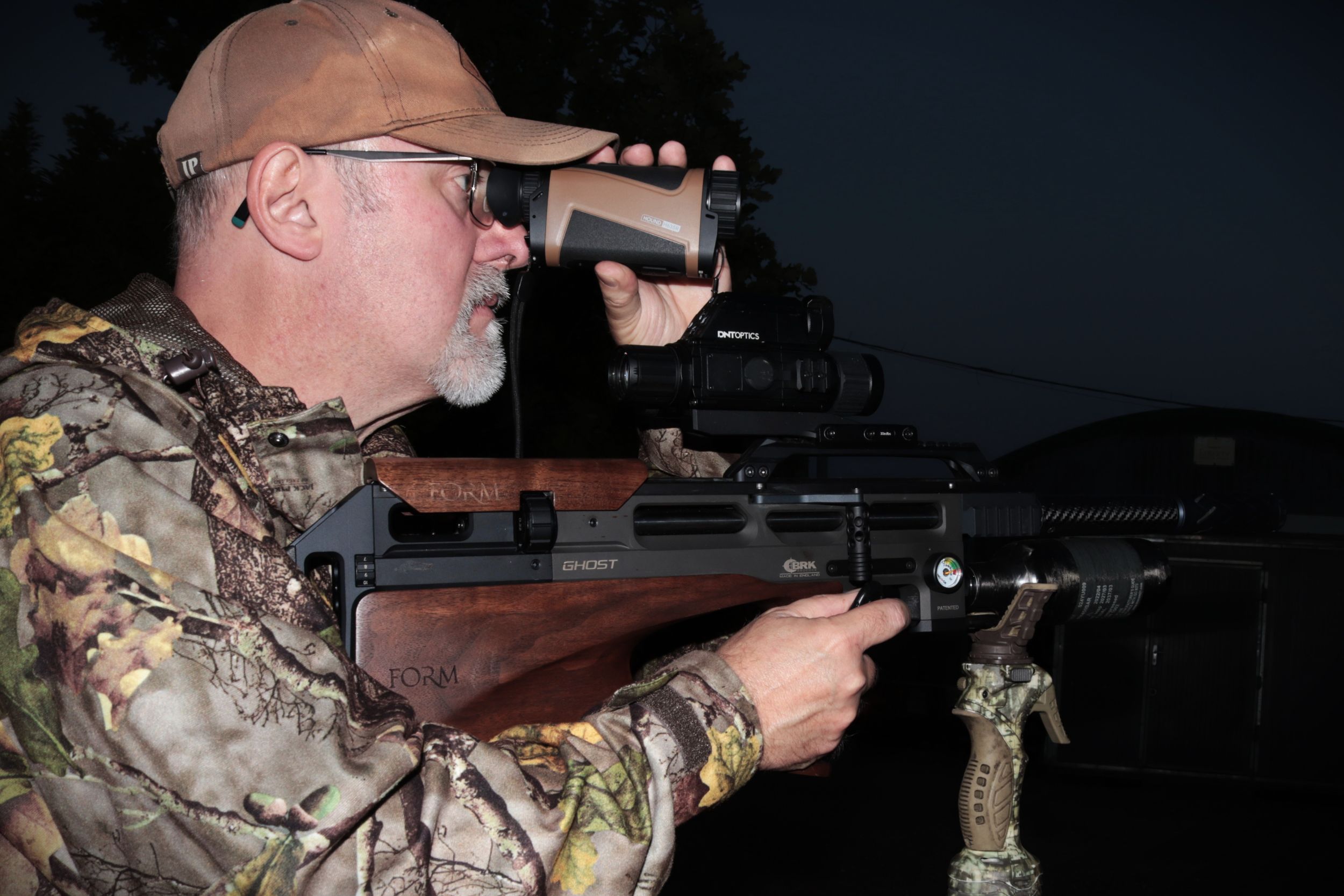
I backed into the cover of a large fir tree to avoid being silhouetted in the moonlight and waited for the rats to re-appear. It didn’t take long for the first rodent to oblige. Rats love the cover of pallets, and I spotted one peering out at me under a pile of them.
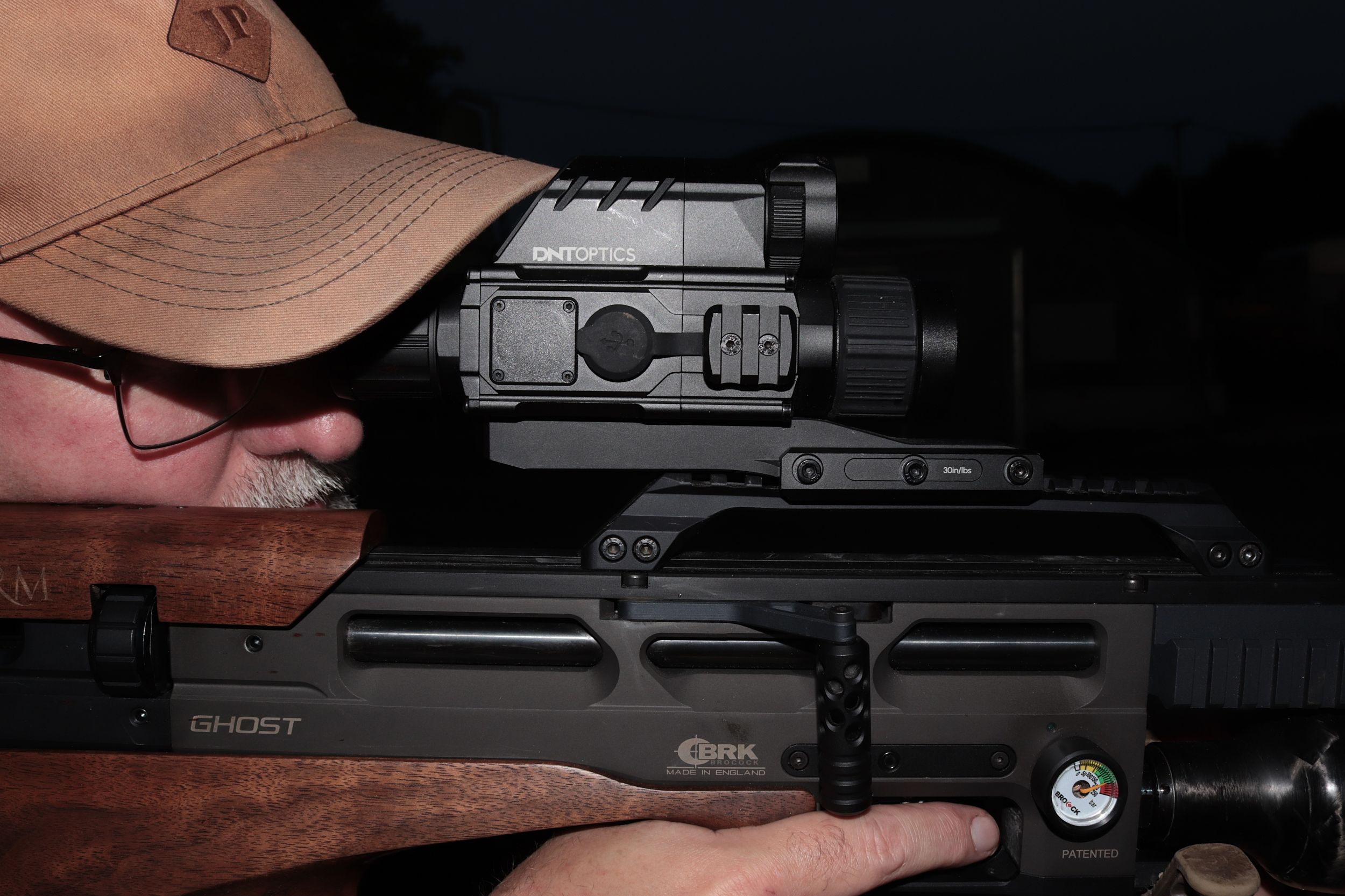
At the push of a button, the ThermNight’s rangefinder indicated a distance of 15 metres, and the scope’s ballistic calculator applied the required amount of holdover, indicated on the red reticle by a green aimpoint. A second or two later and the first rat of the night was down with a clean head shot.
I waited another 15 minutes, but no more rats appeared so I moved a little further around the chicken shed and resumed my routine of scanning with the Hound H635R every few minutes. Eventually I spotted another rat, this time at 16 metres and once again, the ThermNight and BRK Ghost combination delivered and, dead from another clean headshot, the rat slid back out of sight.
Below: Rich takes aim at a rat while the DNT ThermNight's ballistic calculator shows a revised aimpoint with holdover adjustment
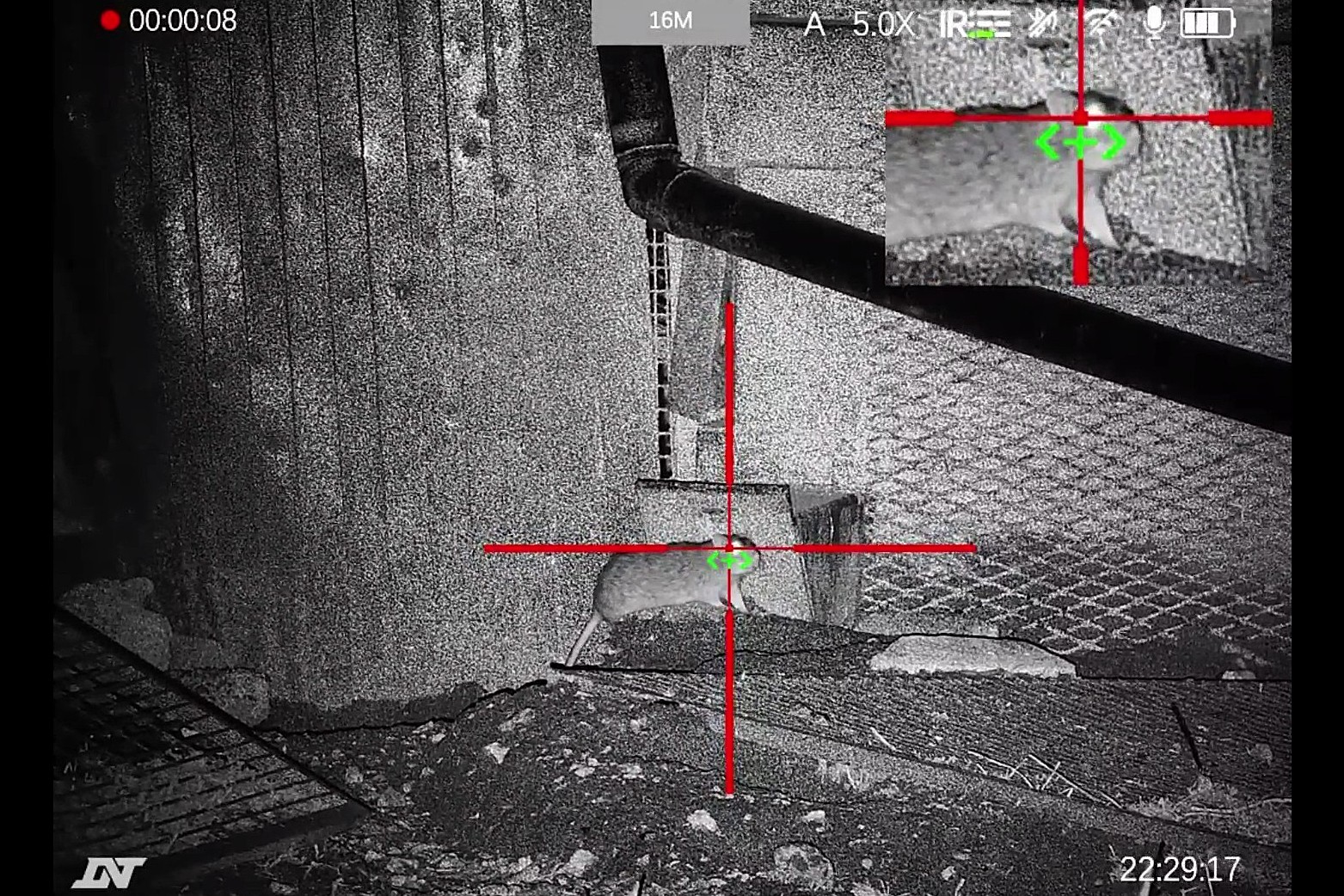
I moved once again to the very back of the shed where I could see a little way underneath to where the rats spend most of their lives. Set on the white hot palette, the Hound H635R revealed the ghostly shapes of rats as they moved around, searching for morsels of chicken food that had fallen to the floor.
Frustratingly, they were so intent on searching they didn’t stand still long enough for me to line up a shot. Eventually one did though and I was able to despatch it cleanly at 12 metres and then added a few more before it all went quiet and I called it quits for the night.
Half a dozen or so rats was hardly a bumper bag, but I was happy with the return given I only had time for a short session. The Hound H635R played a vital role in taking care of the few rats I did see and, by enabling me to survey the entire farm, reassured me the rat population is still on the back foot following my purge a few months ago.
They’ll be back though, and when they are, my BRK Ghost, ThermNight and DNT Hound H635R combination will be ready.
Article first published July 21st 2026

